
Bakery Cookie Boxes
Bakery cookie boxes are built specifically for counter service, where a box has to fold and lock one-handed during a morning rush. An auto-lock or snap-lock base opens square in one motion; a tuck base slows service considerably. That changes the base and closure more than the board. Most bakeries stock several counts, sharing one design so the whole counter looks consistent.
Ours are on Trustpilot, where we can't edit them or choose which ones you see.
Read them on Trustpilot →(opens in a new tab)Four stages, twelve days
Quote confirmed
A specialist checks your spec against the board and comes back with a firm price inside 4 business hours.
Proof approved
You get a flat dieline and a 3D render. Nothing goes to press until you approve it in writing.
On press
Print, die-cut, glue, and fold. You get a press-side photo the day your job runs.
QC and delivery
Every pallet is sampled against the digital proof or physical sample you approved, then shipped with tracking to your dock or 3PL.
If a box doesn't match the digital proof or physical sample you approved, we reprint the run at no charge.
Read the reprint terms →Know exactly what you're ordering.
Bakery Cookie Boxes for Counter Staff Mid-Rush
The person this box is designed for stands behind the counter, not in front of it. With a queue to the door, staff pull a flat box, set it up, fill it and hand it over while the next customer is already ordering. Bakery cookie boxes are bought by bakeries, cookie shops and cafés where that moment repeats hundreds of times a day. Retail cookie brands packing boxes on a production line have different needs, and so do gift sellers. Here, every design choice is judged by how many seconds it adds to or saves from the transaction.
Base, Board and Count Specs for Counter Boxes
A counter box is specified around the person folding it, so the base gets as much attention as the board.
| Feature | Counter spec |
|---|---|
| Board | Food-grade, around 18–24pt |
| Base | Auto-lock or snap-lock |
| Counts | Several sizes, one shared design |
| Inside face | Grease-resistant |
| Storage | Ships and stores flat |
| Tolerance | ±0.5–1mm |
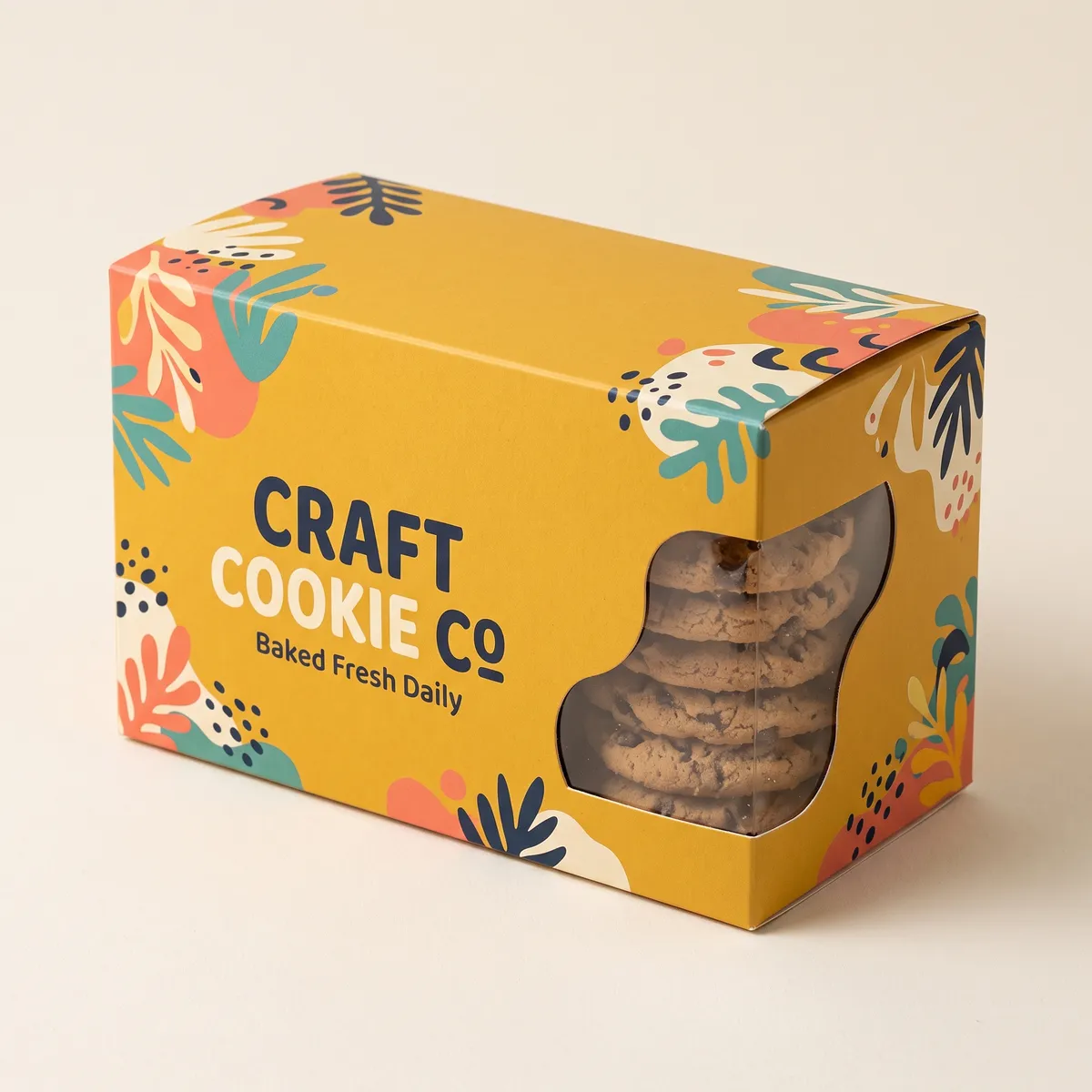
Most counter boxes run on food-grade kraft for counter service, with coated white board as the alternative where an exact brand color matters. The auto-lock base is pre-glued, so it opens square without anyone folding the bottom by hand; a snap-lock base is the lower-cost option.
Why the Base Matters More Than the Board at a Counter
A heavier board barely changes how a counter box performs; a different base changes everything. With a tuck base, staff fold three flaps in sequence and hold them while the box fills. With a locking base, the bottom forms itself as the box opens. Over a morning of service, those seconds add up to real staff time and a shorter queue. The fix is a bottom that drops into place without folding flaps, which is the single most useful spec on this page. It costs slightly more per box, and on a busy counter it pays that back quickly.
Print That Repeats Cleanly Across Every Count
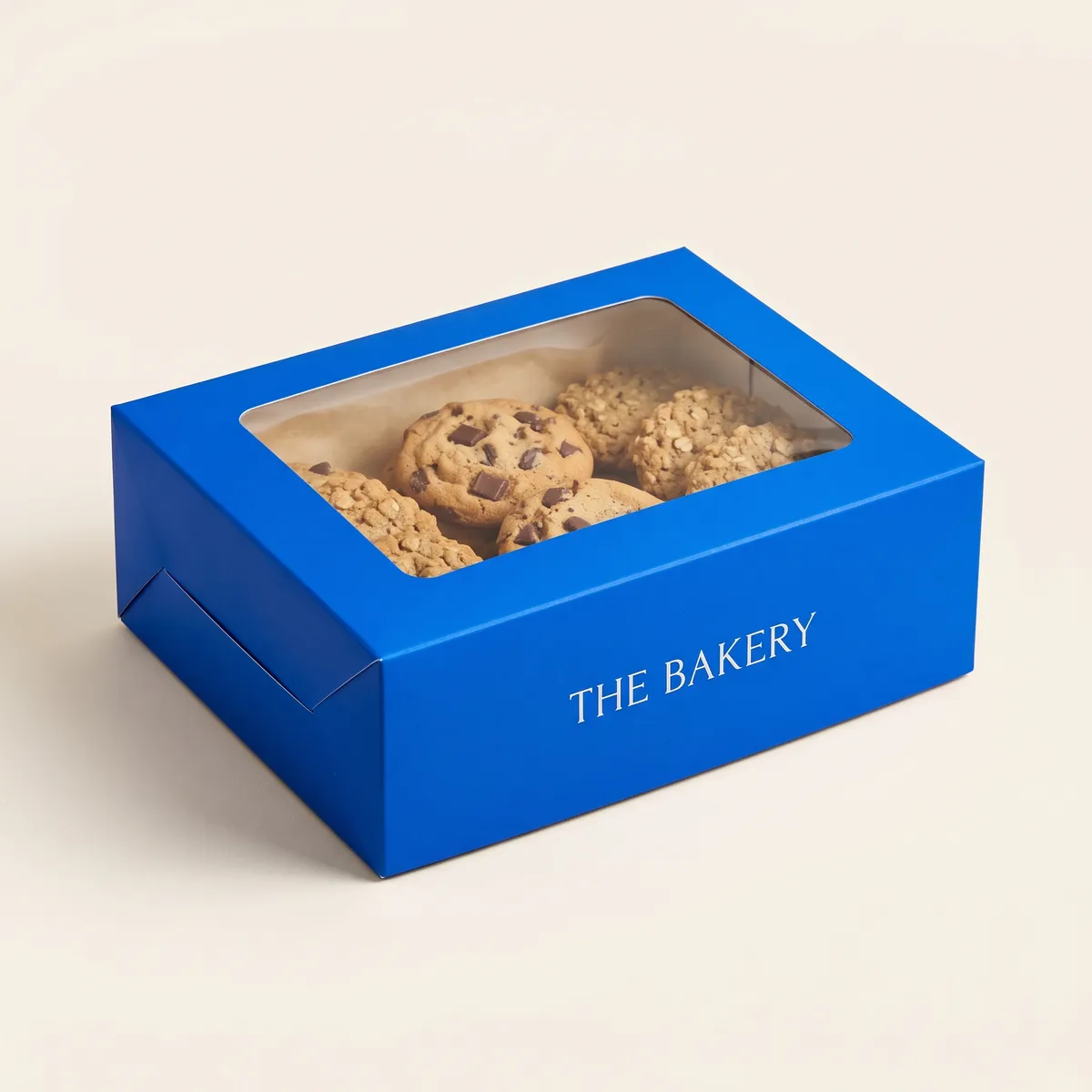
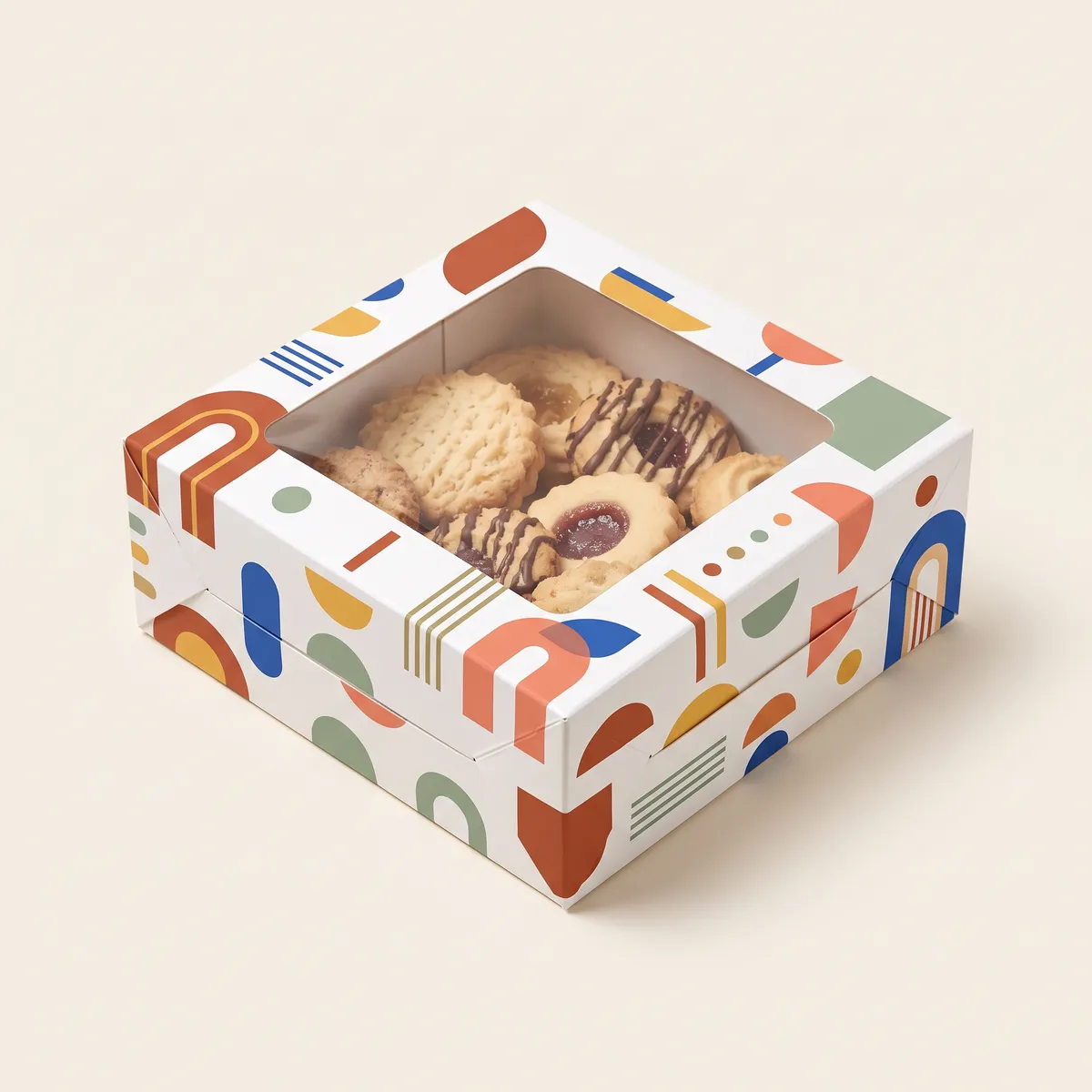
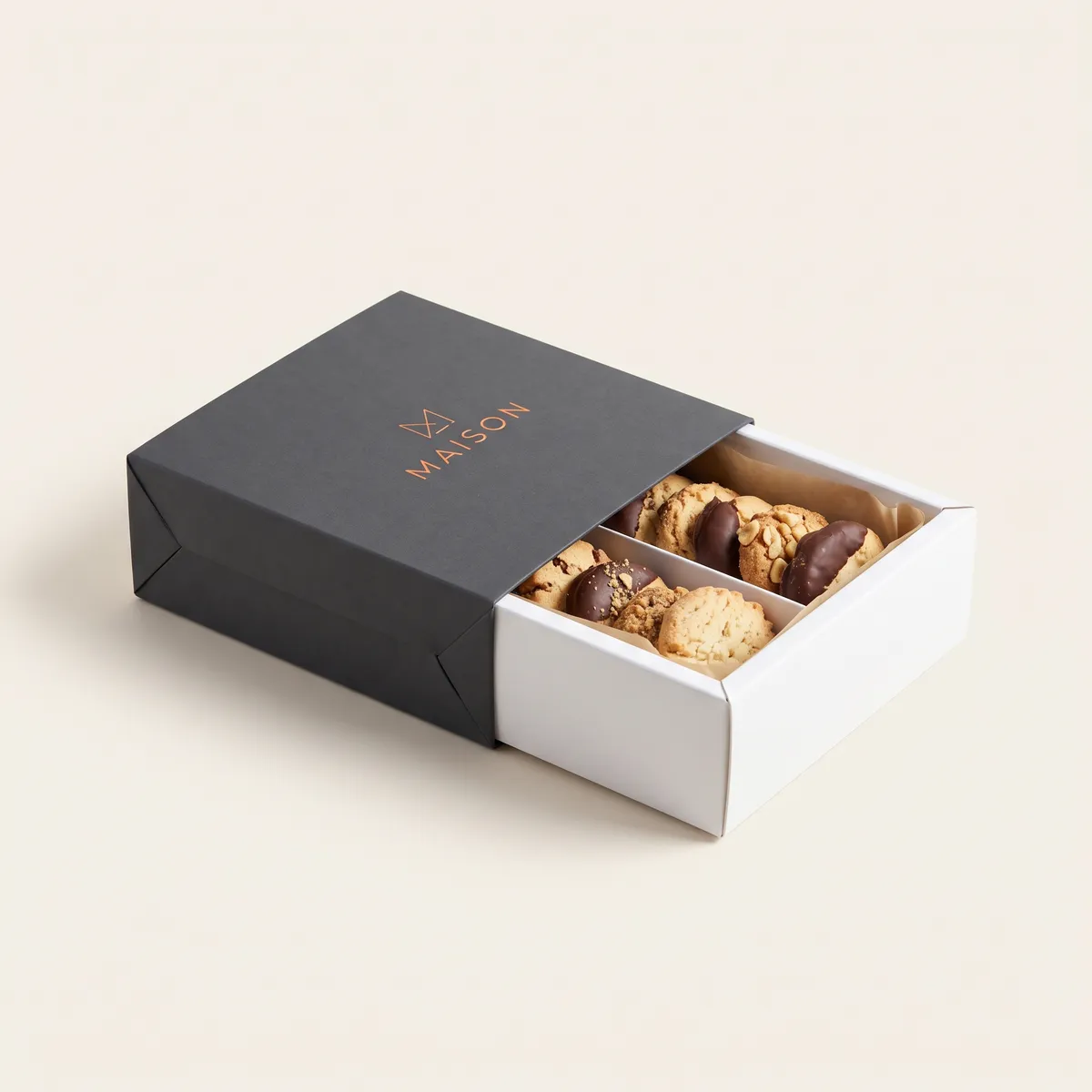
A counter stocks several box sizes, and customers notice when they don't match. The print should work on all of them: a logo sized to read on the smallest box, a brand color that stays identical from the single to the dozen, and no artwork that only fits one panel shape. One or two colors usually does it and keeps reorders cheap. Leave a clear spot for a flavor sticker or price label, since staff will add those by hand. A window in the lid helps customers point at what they want, but it adds a cutting step; skip it on boxes filled to order out of sight.
Bakery Cookie Boxes for Neighborhood Shops and Cafés
Neighborhood bakeries with a morning queue are the heart of this page, boxing cookies to order alongside bread and pastries. Cookie shops selling a dozen flavors from a glass case use counter boxes for every mixed half-dozen. Cafés keep a stack under the register for customers who want a few cookies to take home. Food halls and market stalls with fast turnover use them for the same reason: quick setup, no tape, no fuss. Supermarket in-store bakeries order counter boxes in the largest volumes, often in a single count. Gift sellers and online shops need something else; this format is built for speed, not presentation.
Stocking Counter Boxes Without Running Short
Running out of boxes mid-week is a counter's worst packaging problem, so order on a cycle. Boxes take 8–12 business days to make once the proof is approved; reorder when you're down to about three weeks' stock and you won't get caught short. For the week a promotion outsells your stock, rush is there at an extra cost we quote first. The minimum is 100 boxes. Every box passes a three-stage check, so a faulty base is caught before it reaches your counter rather than in the middle of service. Delivery is included, and flat-packed boxes take little room between orders.
One connected process, start to finish.
Structural Design
Dieline drafted to your exact fit and freight tolerances.
Proof & Sample
Sign off on a digital proof, or request a physical sample.
Tooling
Dies and plates are cut for your job and archived on file.
Production
Print, die-cut, and assembly run under in-line quality checks.
Ship & Reorder
Freight goes out, and the cycle resets for your next run.
Steady process. Powerful results.
Like everything we build, our process is engineered to hold up — no shortcuts, no surprises. Five dependable stages that run the same way every single time, so reorders are just as fast as the first order.
- One dedicated teamFrom first sketch to final freight, the same people carry your order start to finish.
- Dies archived on fileReorders skip tooling and re-setup entirely — we already have your exact spec.
- Checked against your sign-offEvery run is inspected against the digital proof or physical sample you approved.
Set up your file once, correctly
Nine in ten delayed jobs are delayed by artwork, not production. Match these four rules and your proof lands the next morning.
- Bleed1/8 in (3 mm) past every cut line
- Safe ZoneKeep text 1/4 in clear of every crease
- ColourCMYK or named Pantone. No RGB.
- Resolution300 dpi at final size, fonts outlined
No print-ready file?
Send a logo and a rough idea. Our studio builds the production file free with any order over 500 units — you keep the source file either way.
Ask the StudioBackground art must run all the way to the outer bleed edge. Anything inside the white dashed line survives fold tolerance.
What brands say about this box
They live there rather than here, where we can't edit them, delete them, or pick which ones you get to see. That is exactly what makes them worth reading.
Read all reviews on Trustpilot(opens in a new tab)Answers before you have to ask.
What do bakeries need that retail boxes don't?
Speed of assembly, mostly. A counter box has to fold one-handed during a rush, where a retail box is packed once in a production line. That changes the base and closure more than the board.
Can bakery boxes assemble one-handed?
Yes, and that's what to specify for. An auto-lock or snap-lock base opens and locks square in one motion, which is what a busy counter needs. A tuck base slows service noticeably.
Are bakery boxes different in build?
Mainly in the base and closure. Bakery boxes prioritise one-handed assembly during service, so auto-lock bases are standard. Retail boxes are packed in a line, so speed matters less than shelf presence.
What's the turnaround on bakery cookie boxes?
About 8–12 business days from proof approval, auto-lock base included. Rush production is available at a stated premium, with shipping included.
Can I order bakery boxes in several counts?
Yes, and most bakeries need several. Running them together shares setup and keeps the design consistent across counts, which looks better than mismatched boxes on a counter.