Length Width Height: Guide To Learn Box Dimensions LxWxH
Learn how to measure the box dimensions in our comprehensive guide to length, width and height. Understand how these box dimensions impact packaging. Read now!
Length Width Height: A Guide To Box Dimensions
When you hear length, width, height, this reminds you of the mathematics class, but it’s more important than just a mathematical concept. Outside of the mathematics classroom, the definition or vocabulary of these dimensions changes. You say terms like the length of a string, the width of a doorway, the height of a flagpole, and the depth of a pool. And when it comes to packaging or making boxes for products, all these dimensions are used together.
Imagine visiting a packaging partner, and can you guess what is a common question that every packaging expert will ask? It’s about the box dimensions. They will ask you for dimensions, length, width, and height for your box that perfectly fits your product. Gone are the days when only rectangular or square boxes were used. It’s the competitive era where differently shaped boxes are used, and their measurements are different. Understanding the dimensions helps in designing a perfect box for your product that does not compromise on product safety. Cost savings and waste reduction are the plus points.
In this blog, we are going to walk through different shapes and how to measure length, width, and height to craft a perfectly sized box. Let’s get started!
Significance Of Box Dimensions For Custom Boxes: Length, Width, Height
When it comes to designing packaging for your product, keep in mind that it acts as a shield for your product against damage. Minor errors in measurement or tight packaging can compromise your product quality. The dimensions are of more significance when you have to design custom-shaped and custom-sized boxes.
**Example:**If you choose a standard-size 7x7x7 Corrugated Kraft Shipping Box for your brand, selecting the right product size is necessary. Placing a very small product inside a large box cannot be packed perfectly. It can increase the risk of damage or breakage during shipping. A properly sized box keeps the product secure, prevents unnecessary movement, and provides better protection during transit. That is why choosing the right box dimensions is important for safe and efficient shipping.
The height, length, and width play the following roles in your product packaging:
Product Protection
A correctly sized box has no extra spaces that prevent items from shifting from their place during shipping and handling. This reduces the risks of damage and makes sure your product reaches the customer's doorstep in pristine condition.
Cost Efficiency
The correct dimensions significantly reduce the shipping costs. Some of the shipping carriers use dimensional weight based on volume instead of the actual weight of the product to charge the cost. The exact dimensions according to the product packaging needs will reduce the shipping costs.
Storage Efficiency And Optimization
The precise internal and external dimensions make stacking more efficient and utilize the warehouse space by storing the maximum number of boxes and cartons. Storage space is optimized whether in the warehouse, on pallets, or in the delivery trucks.
What Basic Measurement Units Length, Width And Height Are For Packaging?
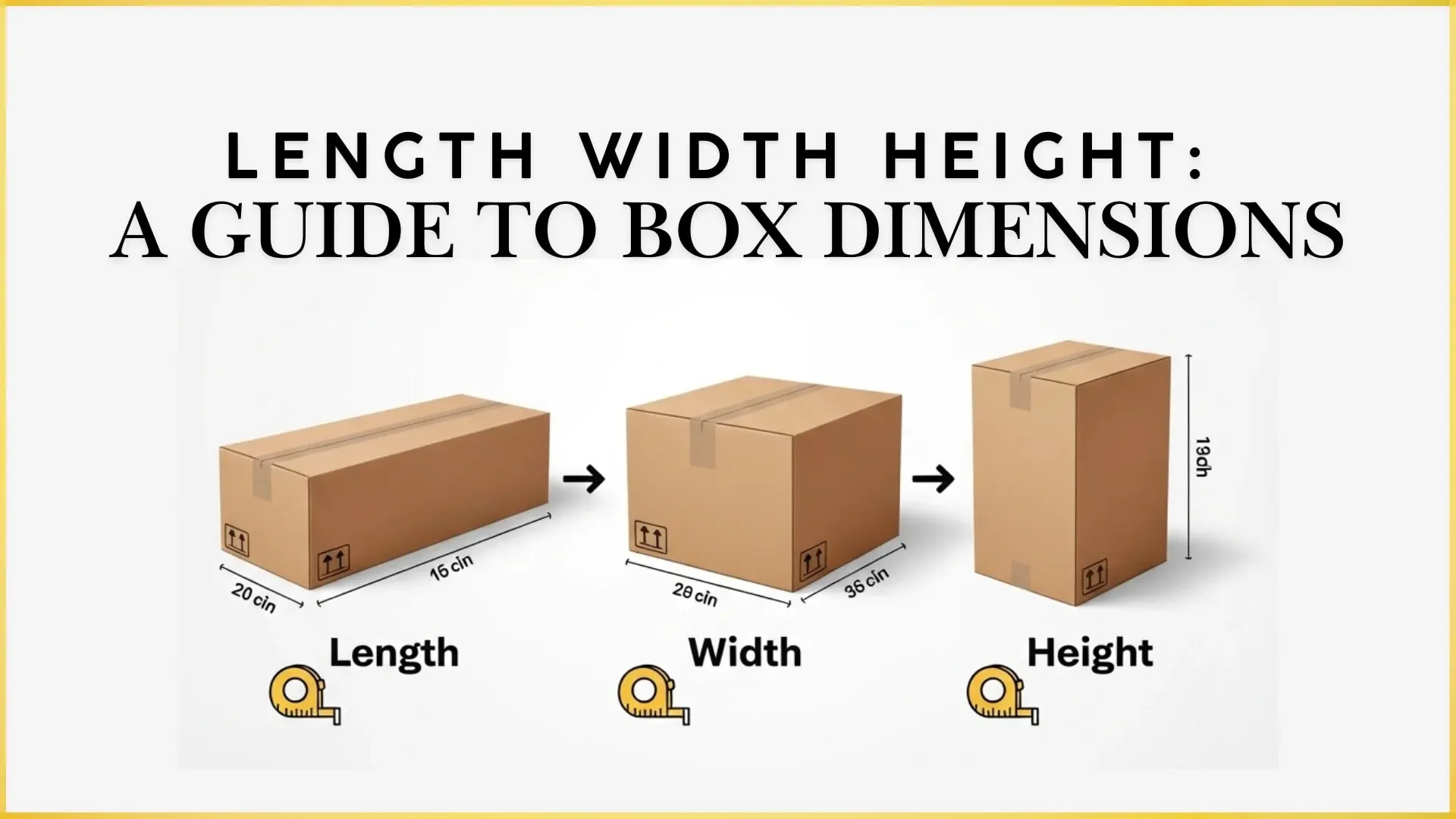
Before you start designing the custom boxes and packaging, the first thing you note down is the length, width, and height. These are the basic measurement units that help you to calculate the cubic size of every physical object using the length x width x height formula. This formula is the same for measuring the boxes and bags sizes. Before moving towards how to measure them, let’s understand what length, width, and height are:
Length
Length is the longest distance between two points of the product or the box base. Length is often measured in inches, centimeters, and meters, depending on the requirement.
Width
The side-to-side dimension of an object, shape, or box is called width, which tells how broad or wide a given object is. It is measured perpendicular to length in linear units, inches, centimeters, and meters.
Height or Depth
The height gives you the measure of how tall an object or box is. It is the vertical measurement from the box’s base to the top of the box. Sometimes, depth is used interchangeably with height, which tells how high or deep an object is.
Height or depth can be measured in either inches or centimeters, usually. For large boxes, meters can also be used.
Examples
Your concept might not be clear about these dimensions. But don’t worry! Let’s understand these dimensions with the help of a short example. Imagine you are witnessing a sports pitch. The long distance between two points of pitch is the length, and how broad the pitch is, which gives you the width. If you observe the distance from its base to the fence, it’s the height.
Let’s take another example of a shoe box. If you look at the box from the front, from the bottom to the top of the box, you get the measure of height. On keeping the box straight, the left-to-right distance gives you the width, and if you keep the box at 90 degree angle, the side panel gives you the length/depth.
In short, the difference between these measures lies in how tall, broad, or wide the parts of the box are.
Length vs Width
In the rectangular prisms and cubes, the length and width are perpendicular to each other. At the front of the box, both measures combine to form a 2D image of the object. Collectively, both measurements suggest how long and wide an object or product can be stored.
Width vs Height
Width and height are also perpendicular to each other, that decide the depth and height of the products to be stored. The front view of the box gives the width but hides the height of a cuboid or rectangular prism box.
Height vs Length
The length from the front view of the box also hides the height of the box. The height and length of the box determine the dimensions of products from left to right and front to back.
How To Write Box Dimensions Of Different Shapes And Dimensions?
Not all boxes are of the same dimensions or shape. Based on these dimensions, the boxes are categorized into two major types that cover almost every shape:
2D Geometrical Shape
The 2-dimensional shape is the flap shape that has two dimensions only. These are length and width with no depth. The two-dimensional packaging is used to ship items that do not have much volume. You can ship photographs, canvas, and legal documents in this type of packaging.
3D Shape
A three-dimensional shape, like a cubic or rectangular prism, is one that has three dimensions with volume. For this packaging, we have three dimensions: length, width, and height. This type of packaging is used for shoe boxes, cereal boxes, folding cartons, tissue boxes, and shipping boxes in everyday life.
How To Measure The Volume Of A Box?
If you want to calculate the right dimensional weight of your box so that the cost can be saved, you need to calculate the volume. This helps brands to estimate the shipping costs and helps them ship products without any hassle. To calculate the volume, you need values for length, width, and height, and put them in the following formula:
Volume= length x width x height
Example
Let’s understand the calculation of volume with the help of a real-time example.
Problem: A box has a length of 12 inches, a width of 12 inches, and a height of 10 inches. What is the volume of the box?
Solution:
Consider the formula,
volume= l x w x h
= 12 x 12 x 10 (inches x inches x inches)
Volume = 1440 cubic inches
The volume of this three-dimensional box is 1440 cubic inches.
That’s how simple it is to calculate the volume of a three-dimensional box. This was about a box with a cubic shape. Let’s learn some more calculations about different shapes of boxes to design custom boxes.
Calculations In Boxes Of Other Shapes
The calculations, like area, volume, and perimeter, are essential as they help us to estimate the size of the shape and its capacity to hold things. When you need to pack a product in a box of some shape other than a conventional square or rectangular shape, these calculated values help you. Let’s comprehend how calculations are performed when you have to deal with a custom-shaped box:
2 D Rectangle Shape Box
The rectangle-shaped box is a two-dimensional shape that does not have depth. For this box, you will need only two measures: the length and the width. With these measures, we can calculate the perimeter that will help you in real-life practical problems, such as fencing a garden or adding ribbons to a box.
Perimeter is calculated as follows:
Perimeter = 2 (Length + width)
Example
A rectangular box has a length of 10 inches, a width of 5 inches, and is 5 inches tall. Calculate its perimeter.
Solution:
Put the values of length and width in the formula of perimeter:
Perimeter= 2 (10+5) inches
Perimeter = 30 inches
The perimeter of the rectangular box is 30 inches.
Three-Dimensional Or Cubic Shapes
For such shapes, we have three measures: length, width, and height that are multiplied together to calculate the volume of the box.
Round Objects
It is quite easier to deal with the conventional rectangular, square, or cubic boxes as they have defined measurements of length, width, and height. But when it comes to round objects or boxes, the measurements and calculations change because they neither have corners nor length, height, and width.
The calculations are slightly changed for round objects. You will need a radius that can be found by measuring the distance from the center to any point on the circumference (border of the circle) of the circular shape. The radius can also be calculated by dividing the diameter (the line that divides the circle equally into two parts) of the circle by a factor of 2.
Anyhow, for a circular or round box, you can measure the dimensions in such a way that the diameter serves both as length and width. The height can be measured from the bottom of the box to the top. Simply use this formula,
Area= Diameter x height
If this is not possible for you, we still have another solution. Just take the measuring tape to measure the distance from one to another. The distance measured must cross the center. If the diameter is 20 cm, then it clearly means all sides of the circle have the same measurement. That’s how you can measure the circular box dimensions.
Tools Or Supplies To Measure Length x Width x Height
We have discussed l, w, and h measurements, but how to measure them? What tools or accessories do we need to measure lxwxh? You just need the following supplies and tools that make measurements a child’s play:
- An inch tape or a measuring scale
- Paper or notepad
- A caliper to measure thickness.
- Rulers for length, width, and height measurement.
- Flexible measuring tapes to facilitate perimeter measurement
- Pen
How To Measure And Note Down The Length, Width, Height Of A Box?
Once you get all the supplies or tools for measurement, you are all set to note the measurements of l, w, and h. Besides the tools, you must know the correct order for precise sizing. Follow this order: length x width x height
Now, follow these steps to measure and note the box dimensions:
- Measure the widest length (the longest side) of the box from left to right and note it down.
- Measure width- the shorter side of the box’s front view.
- Measure the distance from the bottom of the box to the top for height.
The box size now can be found as **length x width x height.**For measurement, use any authentic measuring tape or any math geometry tool. Choose any tool that makes measurement convenient.
Example
Consider a mailer box’s dimensions: 16 inches in length, 12 inches in width, and an 8-inch-high box.
You will note the dimensions down as:
Length: 16 inches, Width: 12 inches, Height: 8 inches
This measurement order is suitable for square or rectangular mailer boxes used for display, storage, and shipping.
Why Exterior And Interior Box Dimensions Matter?
Besides the lxwxh measurement, another thing you must take into account is the exterior and interior box dimensions. Having the same interior and exterior box dimensions is not always true. The dimensions internally and externally can be different. This fact can be understood via an example.
You chose a box after measuring its dimensions precisely for a durable cardboard box, so that your product can fit perfectly. But still, it was not the perfect size. Why? Because the thickness of the durable cardboard box added an extra cm to your current measurement. The same can happen when you choose boxes with walls of different thicknesses. That's enough to emphasize the importance of interior and exterior dimensions.
Interior Of The Box
The interior of the box refers to the internal sides where the product will be placed and will come into contact with the container. For a more precise and accurate measurement, it is recommended to measure the dimensions from inside the box. This will make sure no damage happens to your product by shifting from its place during shipping and handling.
Exterior Of The Box
The exterior means the outer side of the box that may differ from the interior due to the material and box construction.
Generally, it is recommended to measure the box from inside so that no inconvenience occurs and accurate measurements are taken.
How Dimension Order Makes A Difference In Measurement?
The standard order for box dimensions is length x width x height, but sometimes the order changes as below, depending on the vertical or horizontal position:
height x width x length
height x length x width
length x height x width
The dimensions have not changed, but their order is altered. It’s not something very tricky, but a game of position and perception of the box. Every brand has a different size chart, and they follow the measuring techniques accordingly. Let’s understand each order to learn where they are used:
| Order | When To Use? |
|---|---|
| Height Width Length | This order is for the boxes in the vertical position. In this position, the length will be the longest side from front to back, the width will be left to right distance, while the vertical measure will give height. |
| Height Length Width | In horizontal position, height x length x width order is used. Horizontal measurements include length and width, and height is the vertical measurement. |
| Length Height Width | When the object is viewed from the sides, the order of dimensions becomes length, height, and width. Depth or thickness provides the width, the vertical reach becomes the height, while length is the longest measure here. |
Bottom Line
In this blog, we walked through the importance of box dimensions length width height, in ensuring a perfectly sized box. A correctly sized box not only protects your products, but also reduces the waste and shipping costs with dimensional weight. Moreover, we learned how to measure the box dimensions of different-shaped boxes, the role of interior and exterior dimensions, to get the right packaging.
Before designing a custom box, understanding the length, width, and height dimensions of the box will save you from additional costs. This will save your brand reputation by making sure your customers get the products in pristine condition to their doorstep. If you are looking for a packaging expert that can offer you custom boxes in perfect sizes and shapes that not only protect but also attract, Packaging Hippo is your go-to partner. Contact us now!
FAQs
What comes first, length, width, or height?
The standard order of box dimensions suggests that length comes first, then width, and last the height. Anyhow, length comes first or after, depending on the position or orientation of the box.
Is it LxWxH or lxhxw?
According to industry standards for shipping, storage, and display, L x Wx H is the standard order.
What is l*w*h?
This is the formula to calculate the volume of a three-dimensional object or a box with the help of three dimensions: length, width, and height.
How do you measure the height of the box?
Before you measure the height of the box, you need to measure the width and length of the box. The longest side will give you the length, while the shorter side will give you the width. After this, you can measure the side perpendicular to these measures.
What is the correct order of LxWxH?
The correct or standard order is the length x width x height of the box. Here, the length is the longest dimension, the width is the shorter dimension, and the height is the measure from the bottom of the box to the top.
What is length and breadth?
The length is the longest side or dimension of the box, while the breadth is the shorter side or dimension. The breadth and width are used interchangeably, which tells how broad an object can be stored in the box.